4-Week Fit-at-Home Plan: Daily Workouts + Stretches

Fit at Home: A 4-Week Minimal-Equipment Workout Plan With Daily Workouts and Stretches
A simple, structured 4-week routine can make home training feel automatic: clear daily sessions, built-in recovery, and a repeatable progression that doesn’t depend on a full gym. This guide lays out how to set up a small space, choose minimal equipment, follow a week-by-week schedule, and stay consistent with strength, cardio, mobility, and stretching.
What this 4-week plan is designed to do
- Build full-body strength using bodyweight and a few optional tools (bands or light dumbbells).
- Improve conditioning with short, repeatable cardio intervals and low-impact options.
- Reduce stiffness with daily mobility and post-workout stretching built into the schedule.
- Provide clear daily direction so sessions require less decision-making.
- Support progression across four weeks with small increases in volume, time, or difficulty.
For general health targets, a helpful benchmark is meeting weekly movement guidelines like those summarized by the CDC, while layering in strength work as recommended by organizations like ACSM.
Minimal setup: space, equipment, and time
- Space: a yoga-mat-sized area plus room to step forward/back for lunges and hinges.
- Time: aim for 20–40 minutes per day; shorter sessions still count if done consistently.
- Equipment tiers: (1) bodyweight only, (2) resistance band + chair/bench, (3) add light dumbbells or a kettlebell for easier progressive overload.
- Simple substitutes: water jugs for weights, a towel for sliding hamstring curls on smooth floors, stairs for step-ups.
- Comfort and safety: supportive shoes for impact days, clear floor area, stable chair (no wheels) for step-ups or incline push-ups.
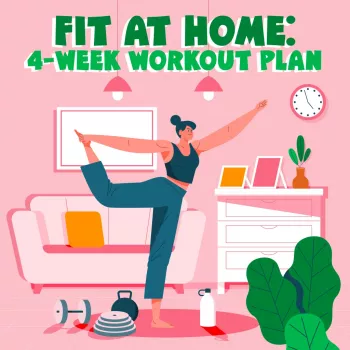
If you want a ready-to-follow calendar that removes daily guesswork, Fit at Home: 4-Week Workout Plan (PDF download) organizes training days, recovery work, and stretches in one place.
Weekly structure at a glance (repeatable rhythm)
- Most weeks work best with 3 strength days, 2 conditioning days, and 2 recovery-focused days.
- Strength days rotate emphasis: lower body + core, upper body + core, full body.
- Conditioning alternates between low-impact steady work and interval-style efforts.
- Recovery days include mobility flow, longer stretching, and optional easy walking.
Sample 7-day schedule (use for each of the 4 weeks with progression)
| Day | Focus | Main work (example) | Stretch & mobility (5–10 min) |
|---|---|---|---|
| Day 1 | Lower body + core | Squats/lunges/hinges + plank series | Hip flexor, hamstrings, calves, glute stretch |
| Day 2 | Conditioning (low-impact) | Brisk walk, step-ups, light cardio circuit | Thoracic rotation, ankle mobility, gentle quad stretch |
| Day 3 | Upper body + core | Push/pull (band rows), shoulder work, dead bug | Chest opener, lats, neck/upper trap release |
| Day 4 | Recovery + mobility | Easy walk + mobility flow | Longer full-body stretch sequence |
| Day 5 | Full body strength | Squat/hinge/push/pull combo circuit | Glutes, hip external rotation, pec stretch |
| Day 6 | Conditioning (intervals) | Timed intervals: work/rest rounds (low impact optional) | Calves, hip flexors, breathing reset |
| Day 7 | Recovery (optional) | Rest or light activity (walk, gentle yoga) | Full-body stretch, focus on tightest areas |
How to progress from week 1 to week 4 (without burning out)
- Week 1: learn movements and choose a starting level that leaves 2–3 reps “in the tank” on most sets.
- Week 2: add a small amount of volume (one extra set, or +2 reps per set) on strength days.
- Week 3: increase difficulty (slower tempo, harder variation, slightly heavier weight/band tension) while keeping form strict.
- Week 4: combine modest volume + difficulty; keep recovery days easy to avoid accumulating fatigue.
- Effort guide: strength sets around 6–8/10 effort; conditioning days around 6–7/10; recovery days 3–4/10.
A practical progression example: if Week 1 uses 2 sets of 8–10 squats, Week 2 goes to 3 sets; Week 3 keeps 3 sets but adds a 3-second lower; Week 4 adds 1–2 reps per set or holds a light weight.
Daily stretching and mobility: what to include
- Post-workout stretching (5–10 minutes): prioritize hips, calves, hamstrings, chest, and upper back for most at-home routines.
- Mobility before training: 2–4 minutes of joint circles, hip hinges, bodyweight squats, and shoulder/scapular movements to raise temperature and range.
- Breathing reset: 60–90 seconds of slow nasal breathing after sessions can downshift the nervous system and improve recovery.
- Pain rule: if a stretch causes sharp pain or tingling, reduce range or swap it; stretches should feel strong but controllable.
For straightforward stretch timing and technique, the NHS stretching guide is a useful reference for keeping stretches steady and not rushed.
Common form and pacing cues for home workouts
Staying consistent for four weeks
If you like printable checklists for sticking with routines (especially when traveling or working irregular hours), pairing your workout calendar with a simple planner can help. A lightweight option is the Minimalist Travel Packing Planner for building a repeatable “gym-in-a-bag” routine (band, mini loop, jump rope, and a plan).
Printable plan option
Fit at Home: 4-Week Workout Plan | Minimal Equipment Exercise Guide PDF | Home Fitness eBook with Daily Workouts & Stretches is designed to be repeatable: finish four weeks, then recycle it with slightly harder variations or slightly heavier weights.
To support the habit side (showing up, planning, reflecting), the Critical Thinking & Problem Solving eBook can be a useful companion for building a consistent decision framework: what to do when time is short, how to adjust when sore, and how to keep momentum without “all-or-nothing” thinking.
FAQ
Is the 30 day fitness at home app free?
Pricing varies by app: many offer a free tier with ads or limited plans and charge for premium programs or coaching. Check the app store listing for subscriptions, trials, and what’s included; a one-time PDF plan can be an alternative to ongoing fees.











Leave a comment